
Introduction
One of the most common questions students ask before applying for funding is simple: “How much will I receive each month?” When it comes to SETA bursaries, the answer is not always straightforward.
Unlike fixed funding schemes, SETA bursaries vary depending on the sector, programme type, and level of study. Some provide full financial coverage with additional monthly support, while others focus mainly on tuition and academic costs.
Understanding how SETA allowances work can help you plan your studies better and avoid unrealistic expectations.
What Is a SETA Bursary Allowance?
A SETA bursary allowance is the monthly or periodic financial support given to students or learners funded by a Sector Education and Training Authority.
These allowances are designed to help cover:
- Living expenses
- Transport
- Meals
- Study-related costs (data, materials)
In many cases, the bursary also covers:
- Tuition fees
- Accommodation
- Textbooks
Background / Purpose
SETA funding is structured to support skills development in high-demand sectors, not just provide cash payments.
This means:
- Funding is often cost-based, not salary-based
- Allowances depend on programme structure
- Priority is given to essential study costs
The goal is to ensure students can complete their studies successfully, rather than rely on a fixed monthly income.
How It Works
The amount you receive depends on:
- The specific SETA (e.g., Services SETA or ETDP SETA)
- Type of programme (bursary, learnership, internship)
- Level of study (NQF level)
- Whether accommodation is covered
Payments may be:
- Monthly stipends
- Once-off allowances (e.g., books, accommodation)
- Direct payments to institutions
Key Features of SETA Bursary Payments
- Not all bursaries include monthly stipends
- Allowances vary widely across SETAs
- Some funding is paid directly to institutions
- Living support is often capped
- Additional support may be provided for data and study materials
Table: Typical SETA Monthly Allowances (2025–2026 Estimates)
| Programme Type | Estimated Monthly Allowance |
|---|---|
| Learnership Stipend | R2,000 – R5,000 |
| Internship Stipend | R4,000 – R7,000+ |
| University Bursary (Living) | ± R2,000 – R4,000 |
| Data/Study Allowance | ± R1,750 – R6,000 (varies) |
| NATED/TVET Support | Structured yearly allocations |
Examples from Different SETAs
Services SETA
- Internship stipends can reach around R7,000 per month
- May include accommodation support
ETDP SETA
- Typically offers around R2,000 per month for living or travel support
- Usually paid over a limited period (e.g., 10 months)
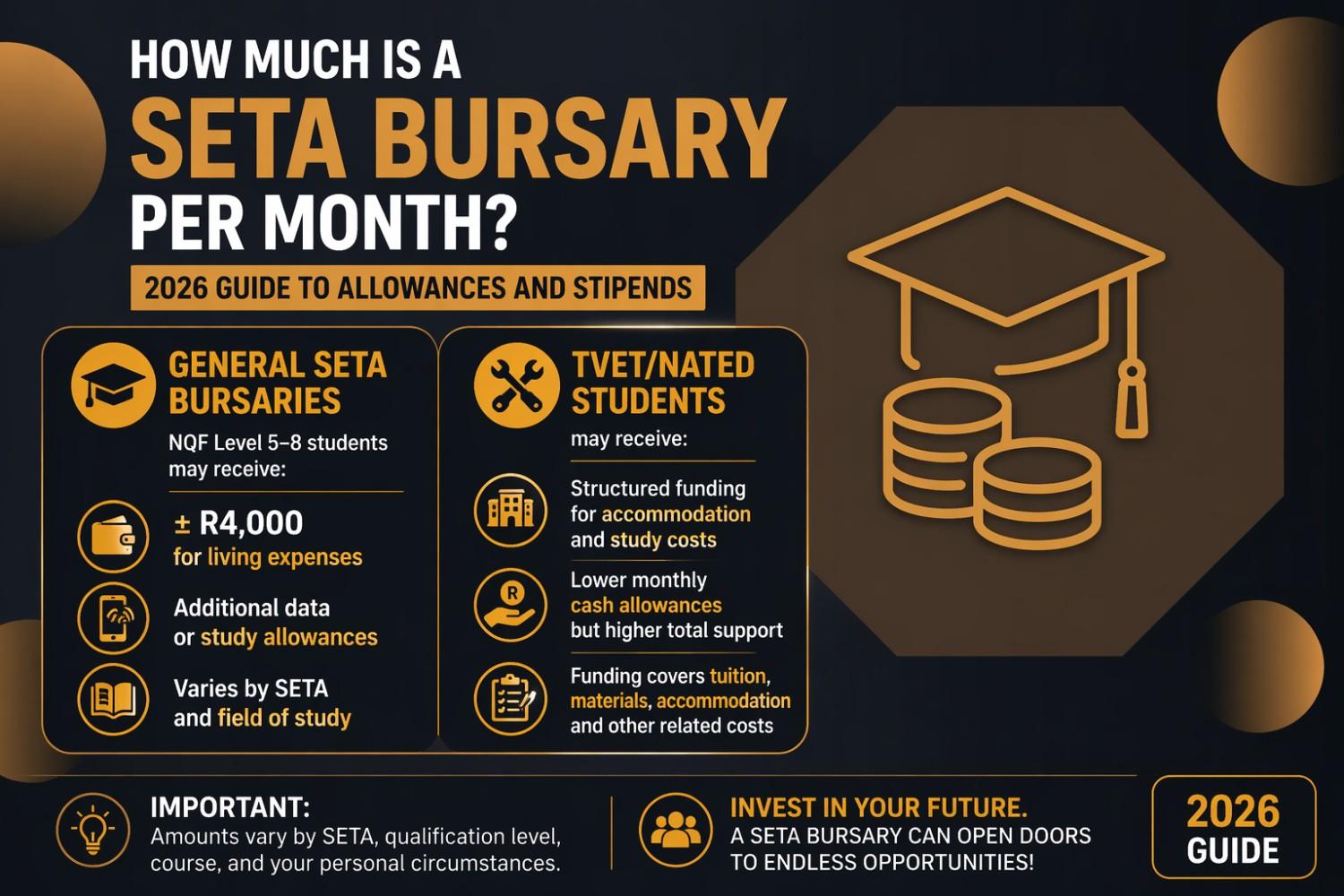
General SETA Bursaries
- NQF Level 5–8 students may receive:
- ± R4,000 for living expenses
- Additional data or study allowances
- TVET/NATED students may receive:
- Structured funding for accommodation and study costs
- Lower monthly cash allowances but higher total support
Who Qualifies for Monthly Stipends?
Not all bursary holders receive monthly payments.
You are more likely to receive a stipend if you are:
- In a learnership programme
- In an internship
- Registered in a workplace-based training programme
Students in traditional university bursaries may receive:
- Less monthly cash
- More direct cost coverage (fees, accommodation, books)
Important Things to Know / Practical Tips
- Do not expect a salary: SETA stipends are support, not full income
- Funding is structured: Some costs are paid directly, not to you
- Check your SETA carefully: Each has different funding rules
- Accommodation matters: If covered, your monthly allowance may be lower
Practical Tip:
Always read the bursary agreement carefully. It will clearly state what is covered and what you will receive monthly.
Why SETA Allowances Matter
Even though the amounts vary, SETA funding provides:
- Financial support to continue studying
- Reduced pressure on families
- Access to education in high-demand fields
- A pathway into employment through skills development
For many students, the combination of funding + career alignment is more valuable than the monthly amount alone.
Conclusion
SETA bursary monthly allowances typically range from R2,000 to over R7,000, depending on the programme and SETA.
However, the real value of a SETA bursary is not just the stipend—it is the full support package, including tuition, training, and career opportunities.
If you are planning to apply in 2026, focus on choosing the right SETA and programme, rather than only the monthly allowance.
FAQ
1. Do all SETA bursaries pay monthly?
No. Some only cover tuition, books, and accommodation without a monthly stipend.
2. What is the average SETA stipend?
Most fall between R2,000 and R7,000 per month, depending on the programme.
3. Are learnership stipends higher than bursaries?
Often yes, because learnerships include workplace training.
4. Can I live on a SETA stipend?
It may cover basic costs, but it is not a full salary.
5. Who pays the stipend?
The relevant SETA or the employer managing the funded programme.

Is it possible for seta to deduct some money in your stipend?