
Introduction
Choosing the right funding option can shape your entire education and career journey. In South Africa, two of the most common funding options are SETA bursaries and NSFAS—but they serve very different purposes.
Many students apply for both without fully understanding how they differ. In 2026, knowing these differences is critical, especially as funding becomes more competitive and targeted.
This guide explains SETA bursaries vs NSFAS in a clear, practical way so you can make the best decision for your future.
What Is a SETA Bursary vs NSFAS?
SETA Bursary
A SETA bursary is industry-focused funding provided by Sector Education and Training Authorities. It supports studies linked to specific sectors such as finance, engineering, ICT, and retail.
NSFAS (National Student Financial Aid Scheme)
National Student Financial Aid Scheme
NSFAS is a government funding scheme that provides financial aid to students from low-income households studying at public universities and TVET colleges.
Background / Purpose
Both funding options aim to improve access to education, but their focus differs:
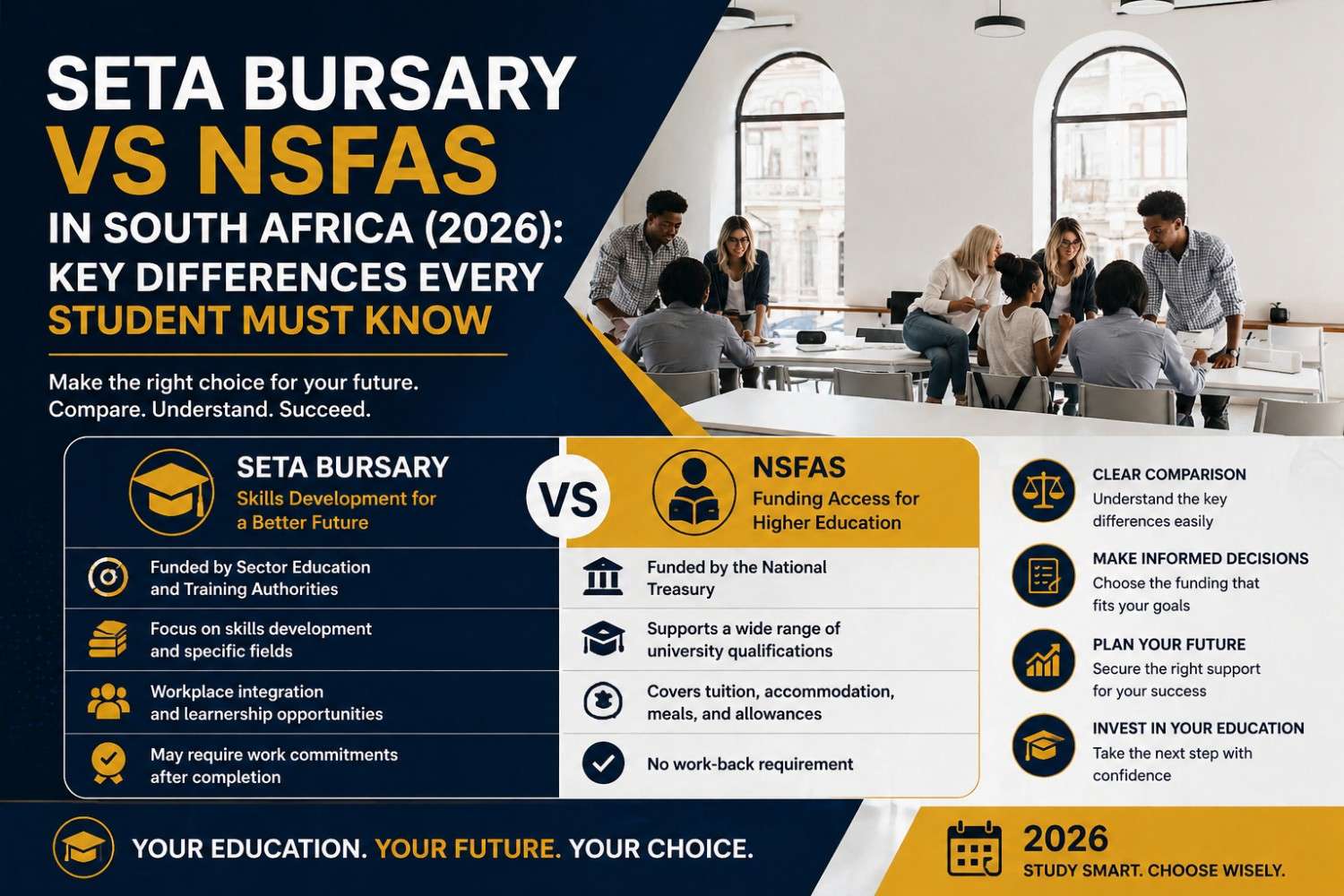
- SETA bursaries focus on skills development and industry needs
- NSFAS focuses on broad access to higher education for disadvantaged students
This difference affects who qualifies, what is funded, and the outcomes.
How It Works
SETA Bursary Process
- Apply through a specific SETA
- Must study in a relevant sector
- Funding is allocated based on industry demand
- May include workplace exposure
NSFAS Process
- Apply through the NSFAS system
- Eligibility based on household income
- Funding approved for universities/TVET
- Funds paid directly to institutions
Key Features / Comparison
SETA Bursary
- Industry-specific funding
- May include workplace experience
- Can include stipends
- Competitive and limited
- Focus on employability
NSFAS
- Covers a wide range of courses
- Based mainly on financial need
- Covers tuition, accommodation, and allowances
- Large-scale national funding
- No direct workplace training
Table Summary of Differences
| Category | SETA Bursary | NSFAS |
|---|---|---|
| Funding Focus | Industry-specific | General higher education |
| Eligibility | Sector + academic + need | Mainly financial need |
| Institutions | Universities, TVET, training providers | Public universities & TVET only |
| Work Experience | Often included | Not included |
| Stipend | Sometimes | Yes (allowances) |
| Competition | Very high | High |
| Career Alignment | Strong (linked to jobs) | Broad |
Who Should Choose SETA Bursaries?
SETA bursaries are best if you:
- Want a career in a specific industry
- Are studying in a scarce skills field
- Want practical experience while studying
- Prefer a career-focused funding route
Who Should Choose NSFAS?
NSFAS is ideal if you:
- Come from a low-income household
- Want to study at a public university or TVET college
- Need full financial support for general studies
- Prefer a broad academic pathway
Important Things to Know / Practical Tips
- You usually cannot receive both at the same time
- SETA bursaries may require specific career paths
- NSFAS is income-based, SETA is sector-based
- Applying to both (separately) increases your chances of funding
- Always check official requirements before applying
Conclusion
SETA bursaries and NSFAS both provide valuable funding—but they are designed for different goals. SETA bursaries focus on skills and employment, while NSFAS focuses on access to education.
In 2026, the best choice depends on your situation. If you want a direct path into a specific career, SETA may be the better option. If you need broad financial support for university, NSFAS is often the right choice.
FAQ
1. Can I apply for both SETA and NSFAS?
Yes, you can apply to both, but you typically cannot receive both at the same time.
2. Which is better: SETA or NSFAS?
It depends on your goals—SETA is career-focused, NSFAS is education-focused.
3. Does NSFAS include work experience?
No, it mainly covers study costs.
4. Do SETA bursaries pay allowances?
Some do, depending on the programme.
5. Who qualifies for NSFAS?
Students from households earning below the income threshold (as set by NSFAS).
