
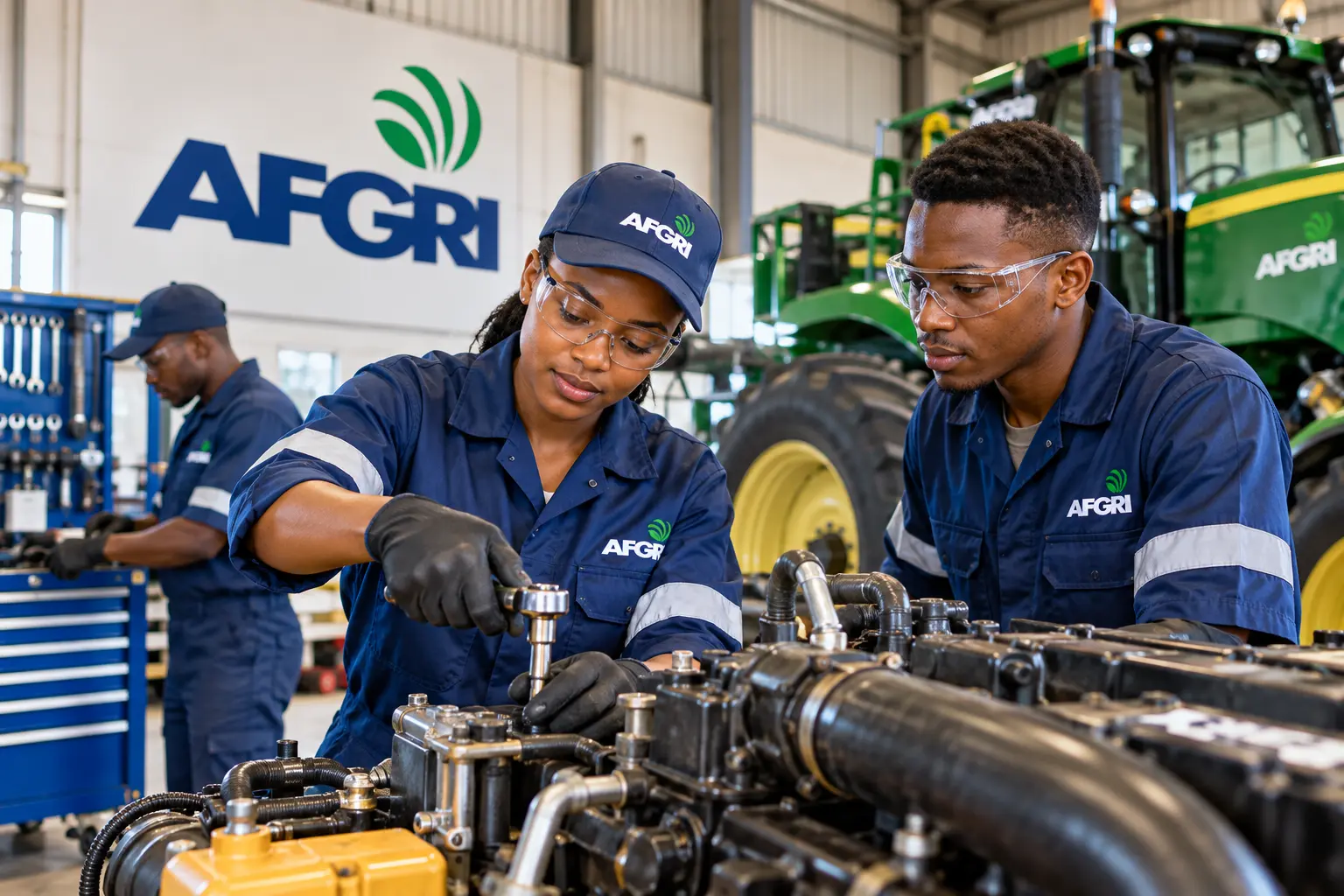
AFG is advertising a three-year artisan training opportunity in 2026 for qualified candidates to develop practical technical skills relating to agricultural and earthmoving equipment.
The programme is open to applicants who meet specific Grade 12 criteria and have a valid driver’s licence. Training and workplace experience are expected to be integral to the three-year development plan, with allocation dependent on operational need across available AFG locations.
Candidates exploring an artisan career path, or any technical training opportunity, should understand the training commitment, first- year probation, potential failure costs and work-back obligation before applying.
AFG artisan training: What applicants need to know
The training programme advertised by AFG lasts three years and is focused on the acquisition of practical technical expertise relevant to agricultural and earthmoving equipment.
This means the opportunity is more likely to be viewed as a career development plan rather than a vacancy for permanent employment.
Applicants should understand, therefore, that the experience on offer combines practical workplace exposure with technical training, and is not limited to one branch or location.
Other information provided confirms that the initial six months are classified as a probation or mutual evaluation period, giving both the employer and artisan candidate the opportunity to determine suitability for the continued employment.
Assessment areas during this time are likely to include technical aptitude, discipline, interpersonal skills and workplace attitude.
Grade 12 requirements for the AFG opportunity
AFG confirms that applicants must have completed Grade 12 with English plus Mathematics or Technical Mathematics.
Care should be taken, however, since Mathematical Literacy is specifically not accepted for this training programme.
Other required candidate competencies are:
A valid driver’s licence
Good communication skills
Basic administration skills
Computer literacy
Among the subjects classified as advantageous are Engineering Science, Physical Science, Engineering Graphics and Design, Diesel Trade Theory and Motor Trade Theory.
Applicants must ensure that they differentiate between the specified requirements and the additional beneficial criteria.
Potential training locations
AFG provides a list of potential locations for the advertised artisan training opportunity.
These are:
Polokwane
Bethlehem
Brits
Middelburg
George
Bellville
Pietermaritzburg
Empangeni
Kempton Park
Nelspruit
Tzaneen
Kokstad
Successful applicants, however, should be aware that placement is subject to employer need at the time of application.
This means that the ideal location may not be available, and candidates should be prepared to relocate, if necessary, for the duration of the training and work-back commitment.
Those who are unable or unwilling to do so should consider alternative artisan training opportunities.
The programme has financial conditions applicants should understand
The AFG training information confirms that costs are covered where required subjects are passed.
There are, nevertheless, conditions attached to the financial support, since applicants may be liable for the costs of repeating modules which are failed.
Applicants should carefully consider, therefore, whether they are prepared to take on the academic demands of the programme.
The initial requirements are not the only consideration for the training, since progression through the modules is likely to become increasingly challenging.
Three-year work-back requirement
One of the most significant conditions, from the perspective of the prospective applicant, is the work-back obligation.
AFG’s information supplied with the opportunity confirms that the work-back period is of equivalent length to the training received.
Since the training is advertised as lasting three years, the suggested work-back commitment would be for a further three years.
This is an extremely important consideration for applicants, especially when evaluating the opportunity against other artisan training programmes.
Candidates should carefully review the work-back obligation in the relevant agreement before accepting an offer from AFG.
Why location and contractual conditions matter
While artisan training can be a valuable development opportunity, the complete programme should be considered from the perspective of the individual needs of the applicant.
The potential relocation, initial six-month evaluation period, academic requirements and work-back obligation should all be taken into account when reviewing the suitability of the AFG training opportunity.
Candidates should make sure that they fully understand any financial liabilities for failed subjects or modules before signing any agreements.
How to apply for the AFG artisan opportunity
Applications for the artisan training opportunity should be submitted via the AFG recruitment website.
All personal details should be provided accurately, and full application forms completed by the candidate.
Applicants should carefully review the current vacancy listing before submitting an application, since the requirements can change.
Application checklist
Before submitting an application form, prospective candidates should be certain that they:
Have Grade 12.
Have English and Mathematics or Technical Mathematics.
Understand that Mathematical Literacy is not accepted.
Hold a valid driver’s licence.
Meet the communication, administrative and computer-literacy requirements.
Are willing to complete a three-year training programme.
Can potentially be placed at a location away from home.
Understand the six-month evaluation period.
Have considered the conditions relating to failed subjects or modules.
Understand the stated three-year work-back obligation.
Closing date
A closing date was not supplied with the information provided for this article.
Applicants should therefore consult the current vacancy listing for the latest application deadline as published by AFG.
Source and verification
Source: The information in this article is based on the supplied AFG artisan training programme information and its online recruitment listing.
The article has been independently structured and written to provide practical information for South African readers. It is not a reproduction of the recruitment advertisement.
Disclaimer
This article is provided for general information and does not guarantee selection, employment, training placement or qualification. Programme requirements, locations and conditions may change. Applicants should verify the latest information directly through the official recruitment platform before submitting an application or accepting a training position.
Editorial policy
Our editorial approach is focused on accurate, useful and transparent reporting. Opportunity articles are written to explain what a programme offers, who may qualify, what applicants should consider and how to verify information before applying.
We do not guarantee that readers will be selected for jobs, learnerships, internships, apprenticeships or training programmes.
Fact-checking policy
We verify important application information against the source material available to us. Requirements, programme duration, locations, financial conditions and application procedures are not presented as confirmed where the source does not provide sufficient information.
Where a detail cannot be established from the supplied information, it is clearly identified rather than being guessed or filled in.
Corrections policy
If a factual error is identified after publication, the information will be reviewed against the relevant source. Confirmed errors are corrected to keep the article accurate and useful to readers.
Significant corrections may be identified transparently where appropriate.
What applicants should take from this opportunity
The AFG artisan programme should be regarded as a long-term technical training opportunity, rather than just another vacancy.
The three-year training commitment, six-month evaluation stage, academic requirements, potential failure costs and work-back obligation are all important considerations for would-be applicants.
Those who meet the initial requirements should carefully review the current vacancy listing and apply using the official application process, rather than relying on third-party application links or unofficial information.
