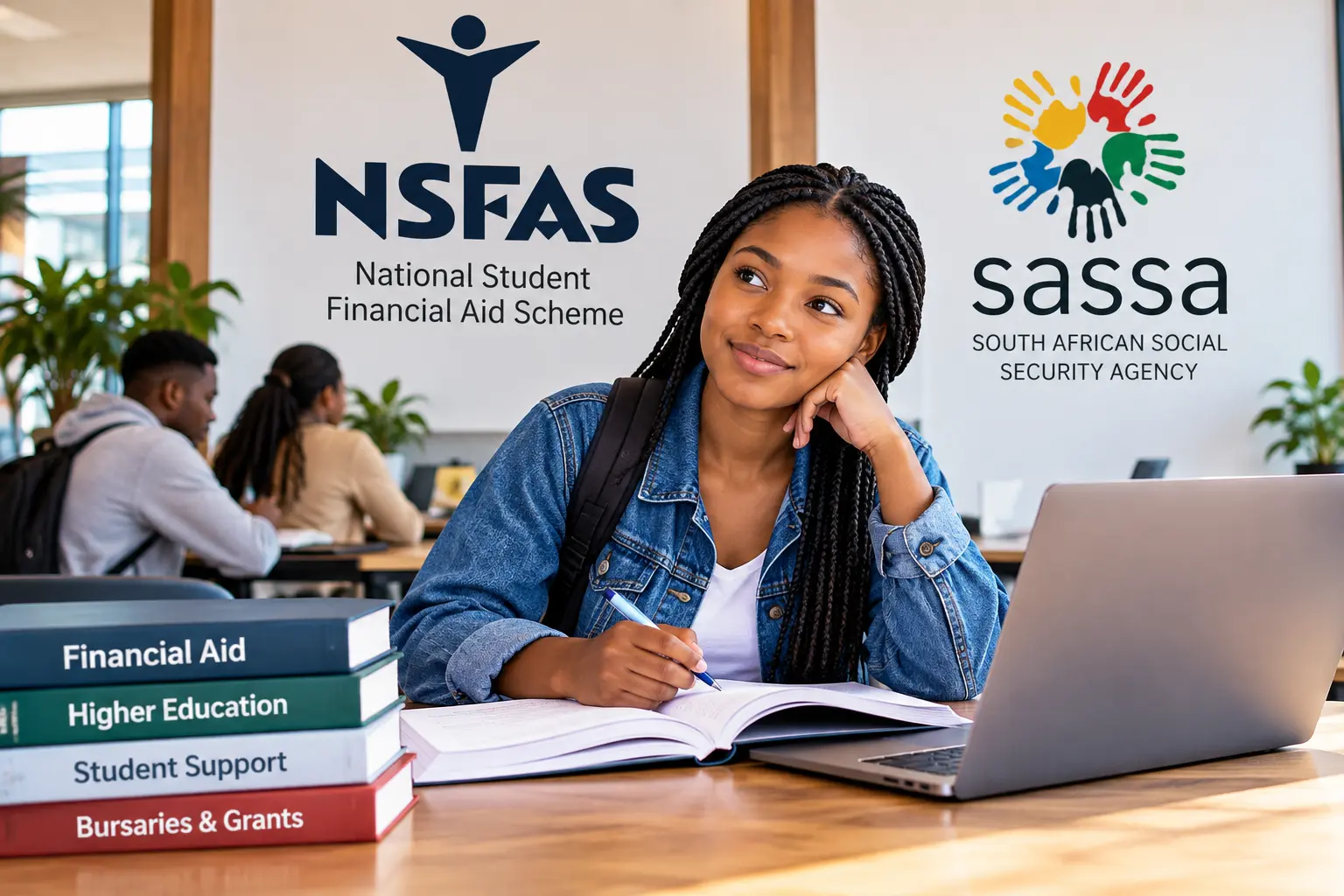
Yes. NSFAS considers verified SASSA information when assessing its applicants for funding. Under the current NSFAS rules, applicants who are verified as SASSA social grant recipients automatically satisfy the financial requirements for a bursary.
The receipt of a social grant from SASSA does not guarantee that a student will automatically receive money from the NSFAS. To qualify for the NSFAS bursary, students need to meet the other NSFAS requirements and intend to study (or pursue a qualification) at a public university or TVET college which is approved by NSFAS.
How does NSFAS use SASSA information?
NSFAS can verify the information of NSFAS applicants against government data and other third-party information, including SASSA.
Applicants who are successfully verified as SASSA social grant recipients automatically satisfy the financial component of the NSFAS eligibility requirements.
This means that they are not required to qualify under the general household-income threshold for applicants who are not verified as SASSA beneficiaries
However, students who are verified as SASSA social grant recipients will still need to meet the other requirements for an NSFAS application.
Does receiving a SASSA guarantee NSFAS funding?
No.
Having a SASSA social grant only satisfies the financial requirements for a bursary. Applicants will still need to satisfy the other eligibility criteria, including the qualification, institution and application requirements.
For example: The NSFAS funds approved students who are studying approved qualifications at qualifying public universities and TVET colleges. Therefore it is incorrect to assume that you automatically qualify for an NSFAS grant if you have a SASSA.
What about the SASSA SRD grant?
There has been some confusion on social media about whether people receiving the SASSA SRD grant are automatically disqualifying themselves from receiving money from the NSFAS.
NSFAS uses a verification process to determine the circumstances of an applicant and its current information confirms that verified SASSA recipients automatically satisfy the financial component of the NSFAS eligibility requirements.
Applicants who are receiving the SASSA should apply for funding through the NSFAS process rather than relying on unverified claims about the SRD grant.
Do SASSA beneficiaries need to provide proof of household income?
In terms of the financial criteria, verified SASSA recipients are treated differently to other applicants.
A verified recipient of a qualifying SASSA social grant automatically satisfies the financial requirement.
In comparison, applicants who are not verified SASSA recipients will generally need to meet the NSFAS household-income requirement.
NSFAS can still request other information and consent for verification as part of the application process.
Can someone receiving SASSA apply for NSFAS?
Yes.
Receiving a qualifying SASSA social grant does not preclude you from applying for the NSFAS, but you will need to satisfy the other requirements.
Applicants should also confirm whether their requested university or qualification qualifies for support from NSFAS.
What income limit applies to other applicants?
NSFAS currently has a household-income threshold for other applicants who do not receive a qualifying SASSA social grant.
The threshold is generally R350,000 or less in terms of combined gross household income per year.
For applicants with a disability the applicable threshold is generally R600,000 or less per year.
These figures relate only to the financial requirement and do not guarantee that applicants will receive funding.
What other requirements apply under NSFAS?
An applicant who is receiving a SASSA social grant must still satisfy the other applicable requirements. According to the circumstances of the individual, this may include:
Being eligible to apply for money from the NSFAS.
Studying or intending to study at an eligible public university or TVET college.
Completing an approved qualification.
Meeting the applicable academic requirements.
Completing the NSFAS application correctly.
Providing required information and documents.
Successfully completing the applicable verification process.
What does the NSFAS funding cover?
For eligible applicants who are approved for funding, the NSFAS can cover costs associated with approved education-related expenses, including:
Registration fees
Tuition fees
Learning material
Accommodation, where applicable
Living allowance
Personal care allowance
Transport, where applicable
The applicable allowances and amounts can vary according to the applicable NSFAS rules and the circumstances of the individual.
NSFAS and SASSA have different roles
NSFAS and SASSA are two separate government entities which have different functions.
The SASSA is responsible for administering South Africa’s social assistance programmes.
NSFAS, on the other hand, provides financial assistance in the form of student grants to qualifying students who are studying at qualifying public universities and TVET colleges.
The interaction between the two organizations relates to the verification of information. The NSFAS is able to use information from SASSA when determining the financial circumstances of an applicant.
SASSA beneficiaries still need to apply for NSFAS
Having a SASSA social grant does not register an applicant for NSFAS. Applicants who are receiving a SASSA social grant will still need to submit an application for funding through the official application system.
The application process generally involves:
- Creating or accessing a myNSFAS profile
- Completing the application form
- Providing the required personal information
- Complying with the consent process
- Providing documents, where required
- Submitting the application
- Tracking the application
Students should keep a record of their NSFAS application reference and track the progress of their application using their communication channels.
Students should not rely on social media claims
There are often conflicting claims on social media about the interaction between the two organisations.
Some claims can be confusing or misleading about the circumstances in which a student qualifies for money from the NSFAS.
The safest option is to rely on the latest information from NSFAS and allow the organisation to verify your circumstances.
Students should also be aware that applications for NSFAS funding are free of charge and that they should not pay an individual who claims that they need to provide payment to submit an application or guarantee funding.
What students should do
If you receive a SASSA social grant and intend to study at a public university or TVET college, you can apply for a bursary from the NSFAS if you meet the applicable eligibility criteria.
Before submitting an application, students should:
Check that their requested institution qualifies for NSFAS funding
Ensure that their requested qualification is approved
Confirm that the personal information they provide is correct
Complete the required consent process
Provide documents, where required
Submit the application before the applicable closing date
Track the progress of their application after submitting it
The key difference
A simple summary of the relationship between the two systems is:
The verification from SASSA can satisfy the financial requirements, but does not guarantee that the applicant will receive funding from NSFAS.
Students who receive social grants from SASSA still need to meet the other NSFAS requirements and successfully complete the application and verification process.
Editorial Policy
This article is produced independently for the benefit of students and families in South Africa. We aim to provide information on student-funding rules based on reliable information and distinguish between confirmed requirements and third-party claims.
Fact-Checking Policy
The information in this article is based on current NSFAS eligibility and application information. Rules relating to funding can change between academic years and students should confirm the latest requirements before submitting an application for a bursary.
Corrections Policy
If an error is identified, the information will be reviewed against the relevant official information and corrected where appropriate if the change can be verified.
Disclaimer
This website is an independent information platform and is not affiliated with the NSFAS or the SASSA.
This article is provided for general educational and informational purposes and does not guarantee that a student will receive funding from NSFAS.
Students should confirm their eligibility and current requirements through the official NSFAS application system.
Source
Information for this article was checked against current NSFAS information relating to SASSA verification, financial eligibility, application requirements and student funding.
