
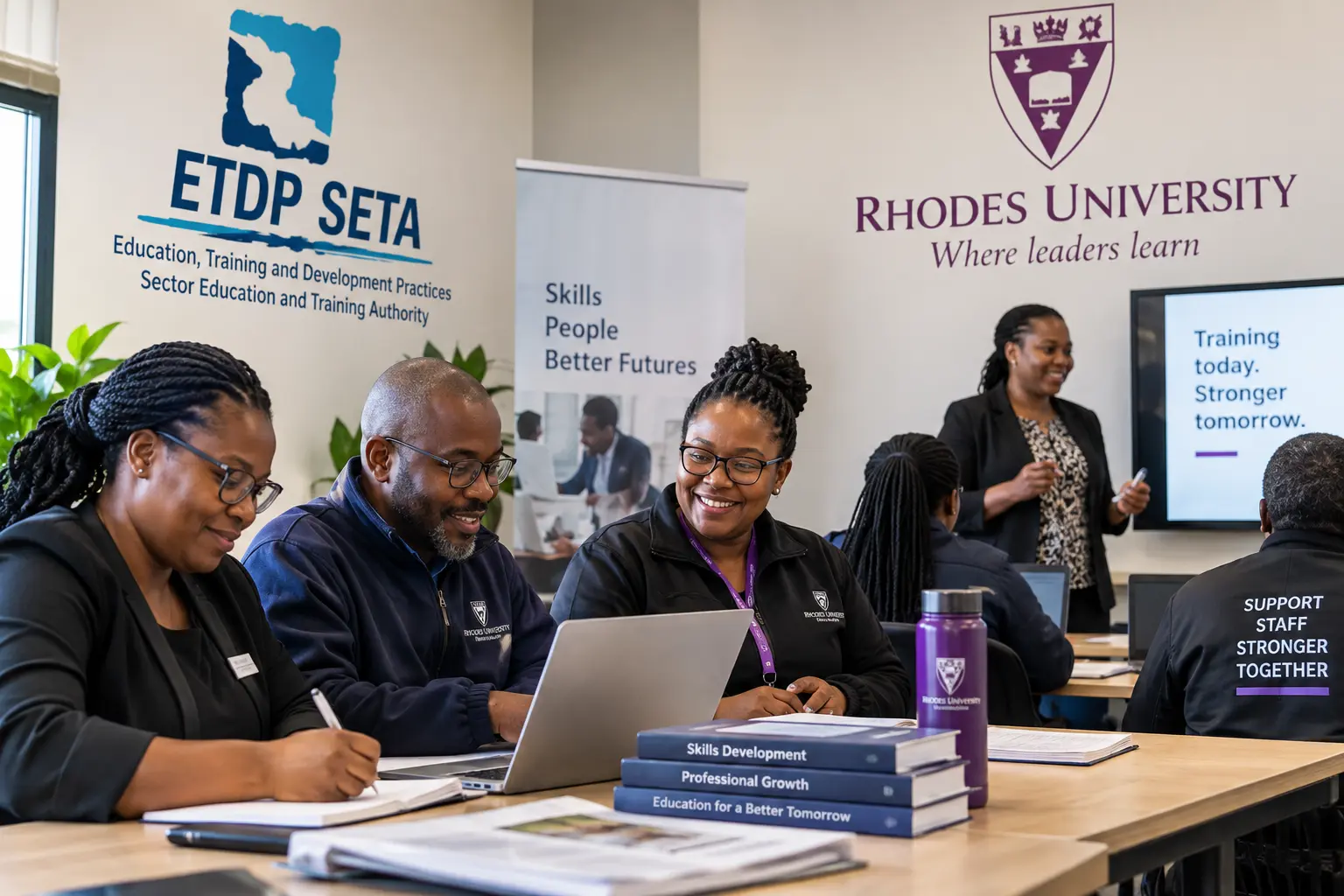
The Education, Training and Development Practices Sector Education and Training Authority (ETDP SETA) invested R780,000 in two learnership programmes at Rhodes University to upskill support staff.
The programmes offered employees in operational areas the chance to develop additional workplace skills whilst continuing to contribute to the workings of the university.
30 staff members participated in the initiative. With 28 from Food and Catering Services and the remaining two from Grounds and Gardens.
Two learnership programmes launched
The R780,000 investment provided two distinct learnership programmes.
The first programme was dedicated to Grounds and Gardens employees and the other was for support staff working in Food and Catering Services.
The training was facilitated by Production Management Institute (PMI) with Rhodes University as host.
The R780,000 investment demonstrates how SETA funding can be leveraged to deliver workplace skills development within higher education institutions and invest in employees occupying essential operational roles.
30 support staff benefited
The learnership initiative brought together staff from two vital operating areas within the university.
The majority of the participants (28 out of 30) were from Food and Catering Services.
A further two staff members from Grounds and Gardens took part in the programmes.
For these learners, the opportunity provided the chance to develop their existing workplace capabilities through acquiring new knowledge and formal credentials relevant to the work they do.
Why workplace learnerships are important
Learnerships are an integral mechanism within South Africa’s skills development strategy, combining elements of learning and workplace experience.
They represent an important tool for employers such as universities to develop existing staff and address skills-shortages in particular areas of operation.
SETA-funded programmes such as this one provide an opportunity for further investment in employees who may not traditionally have access to the same development opportunities as more highly profiled academic staff.
In this case, the focus on catering and grounds staff highlights the potential for workplace skills development to extend to operational areas within higher education institutions.
ETDP SETA’s responsibilities
ETDP SETA is responsible for skills development within South Africa’s education, training and development sector.
The learnership initiative at Rhodes University is one example of how SETA funding can be utilised to develop the capabilities of employees within the target sector.
Whilst many SETA-funded programmes focus on students entering the workforce, this initiative demonstrates how the skills development programmes can be used to build the capabilities of existing employees.
Developing support staff
The learnership initiative also provides an example of how skills development funding can be leveraged to invest in the capabilities of support staff.
The collaboration between ETDP SETA, PMI and Rhodes University provided the necessary infrastructure to deliver the programmes and ensure that participants could link the skills and knowledge gained to their workplace practice.
For support staff, this type of learnership experience can be especially valuable, as it directly addresses the realities of the workplace environment that they operate in.
Further insights for SETA-funding
The initiative provides an insight into the ways that SETA funding can be used to develop the skills of employees at institutions of higher education.
Universities are dependent on extensive support staff to maintain operations. Catering, grounds maintenance and other supporting services are critical to ensuring that the university can continue to operate smoothly. This type of operational staff therefore represents an important area for skills development investment.
The R780,000 investment and 30 participants demonstrate how workplace skills development can be targeted at employees in practical service areas.
Source
Source: Rhodes University archive information supplied for this article.
Editorial Policy
This article has been independently produced from the information provided. It focuses on interpreting and explaining the learnership initiative, rather than presenting the information verbatim.
No further requirements, qualifications, stipends or application instructions have been included as they were not contained in the information supplied.
Corrections Policy
Should any errors be identified, the information will be double-checked against the source material and corrected where necessary.
Disclaimer
The program described in this article relates to the information supplied and does not represent a current opening for learners unless a new recruitment announcement is separately issued. Readers are advised that they should not assume that applications are currently open based on a historical initiative.
