
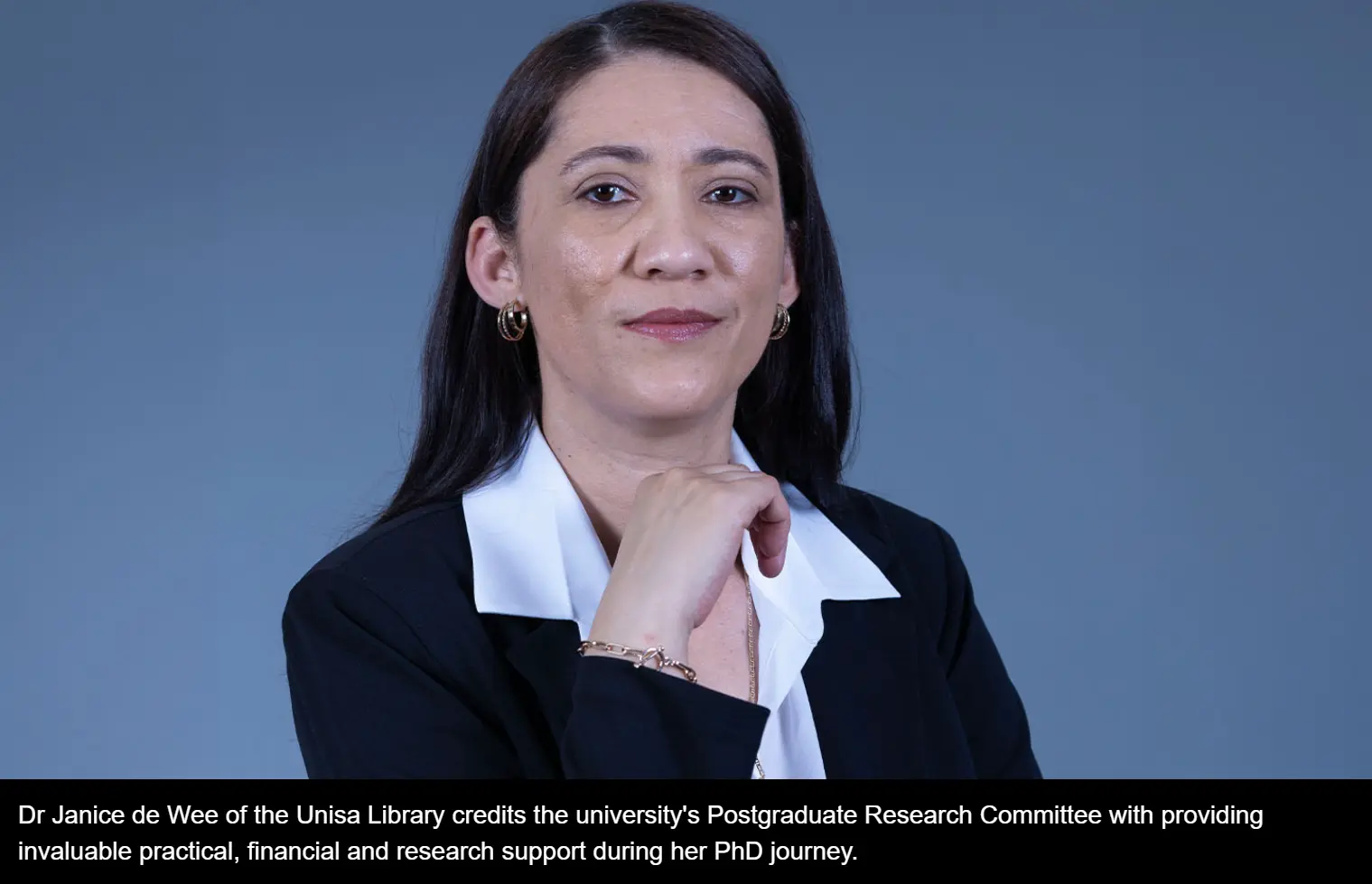
Completing a doctoral degree while managing professional responsibilities and family commitments can be a difficult undertaking. For Dr Janice de Wee of the University of South Africa (Unisa), institutional support, careful planning and encouragement from family members played an important role in completing her PhD.
How Unisa’s Research Support Helped Dr Janice de Wee Complete Her PhD While Balancing Work and Family
In a story published on 10 November 2026, Unisa highlighted how its Postgraduate Research Committee (PRC) provided practical, financial and academic assistance during Dr de Wee’s doctoral journey.
Her experience also draws attention to the importance of universities supporting their professional and administrative employees who want to pursue advanced academic qualifications while continuing to work.
Dr Janice de Wee’s Academic and Professional Journey
Dr de Wee’s interest in academic librarianship began after completing a bachelor’s degree in Information Science at the University of Pretoria.
She joined the university’s Health Sciences Library in 2003, marking the beginning of her professional career in academic libraries.
She subsequently completed her honours degree at the University of Pretoria in 2005.
In 2011, she enrolled in a Carnegie-funded master’s programme in Information Technology for librarians, graduating cum laude in 2013.
Dr de Wee joined Unisa in June 2016, where she took responsibility for the Library’s Research Planning and Quality section.
Her work involved supporting operational and strategic planning, monitoring and reporting, quality assurance, risk management, business continuity and compliance.
These professional responsibilities helped shape her research interests and informed the direction of her doctoral studies.
PhD Research Focused on Social Media Governance in Academic Libraries
Dr de Wee began her PhD studies at the University of Pretoria in 2017.
Her research focused on developing a risk-focused social media governance framework for academic libraries.
The research brought together several areas of interest, including social media, risk management, governance and strategic planning.
It explored how academic libraries can manage social media platforms through appropriate governance structures and risk management frameworks.
Her research was also influenced by her previous experience as a library and information services risk champion and social media trainer.
Explaining her motivation for pursuing the research, Dr de Wee said she wanted to move beyond traditional library sciences and explore a subject that would allow her to contribute new ideas to the profession.
She also emphasised the importance of choosing a research topic that would maintain a student’s interest throughout the demanding doctoral process.
Balancing Doctoral Studies, Employment and Family Responsibilities
Completing a PhD while holding a professional position and raising a family presented several challenges.
The difficulties increased when her research fieldwork coincided with the COVID-19 pandemic.
Remote working and homeschooling added further pressure as she attempted to balance academic responsibilities with family life.
Dr de Wee acknowledged the important role played by her husband and mother during this period.
She described them as her main personal support system, while also recognising the assistance she received from her department.
Her experience illustrates some of the difficulties faced by working professionals who pursue postgraduate qualifications while managing responsibilities outside university life.
How Unisa’s Postgraduate Research Committee Provided Support
One of the important factors in Dr de Wee’s doctoral journey was the assistance she received through Unisa’s Postgraduate Research Group (PRG) and its Postgraduate Research Committee.
The support included research development leave, financial assistance and guidance through different stages of the research process.
She received four months of research development leave, allowing her to concentrate on data collection, analysis and thesis writing.
At the time, the PRC was responsible for approving research development leave applications from PRG members. Unisa explains that this responsibility has since moved to Human Resources.
The committee also assisted Dr de Wee with funding towards data analysis and thesis editing.
She received additional support relating to ethical clearance and opportunities to participate in international conferences.
Dr de Wee credited the committee’s assistance as an important contribution to completing her doctoral studies.
She also acknowledged Ms Amisha Benode, Programmes and Projects Officer of the PRG and PRC, for helping her navigate research processes and information requirements.
Why Research Support Matters for Working Professionals
Dr de Wee’s experience highlights the role that institutional research support can play in helping university employees pursue postgraduate education.
Doctoral studies require considerable time, financial resources and sustained academic commitment. For employees who also have professional and family responsibilities, access to research leave and financial assistance can make a meaningful difference.
Her experience also demonstrates how professional experience can inform academic research.
By drawing on her background in academic libraries, social media training and risk management, she developed research addressing practical governance challenges within the library sector.
In October 2026, she was seconded to serve as Acting Executive Director: Library and Information Services at Unisa, adding another milestone to her professional career.
Dr de Wee’s Advice to Employees Considering a PhD
Dr de Wee encouraged professional and administrative staff considering doctoral studies to plan carefully and develop supportive relationships.
She highlighted the importance of connecting with people who understand the demands of postgraduate research.
Her advice was particularly relevant to employees who must balance academic commitments with demanding professional roles.
She said:
“My advice to other professional and administrative staff is to plan carefully, build a support network and find people who understand the doctoral journey. Never underestimate the importance of surrounding yourself with supportive people.”
Her message reinforces the importance of preparation, personal commitment and institutional support when pursuing a doctorate.
What Her Achievement Means for Unisa’s Research Community
Dr de Wee’s achievement is more than an individual academic milestone. It also highlights the contribution that professional and administrative employees can make to research and knowledge development within universities.
Her doctoral work addresses social media governance in academic libraries, an area that has become increasingly relevant as institutions rely on digital communication platforms.
Unisa’s account of her journey also highlights the value of providing employees with opportunities to develop academically without having to abandon their professional responsibilities.
The university considers structured research support an important resource for professional and administrative staff pursuing postgraduate qualifications.
Sources and Verification
This article is based on an official Unisa news publication dated 10 November 2026.
Primary source: University of South Africa – How Unisa’s research support helped Dr Janice de Wee complete her PhD.
Source verification: The academic history, research topic, professional responsibilities, research development leave, financial assistance and quotations attributed to Dr Janice de Wee are drawn from Unisa’s published account.
Editorial note: This article reports on an individual doctoral achievement and Unisa’s institutional research support. It does not suggest that the same funding or research leave arrangements are automatically available to all postgraduate students or employees.