
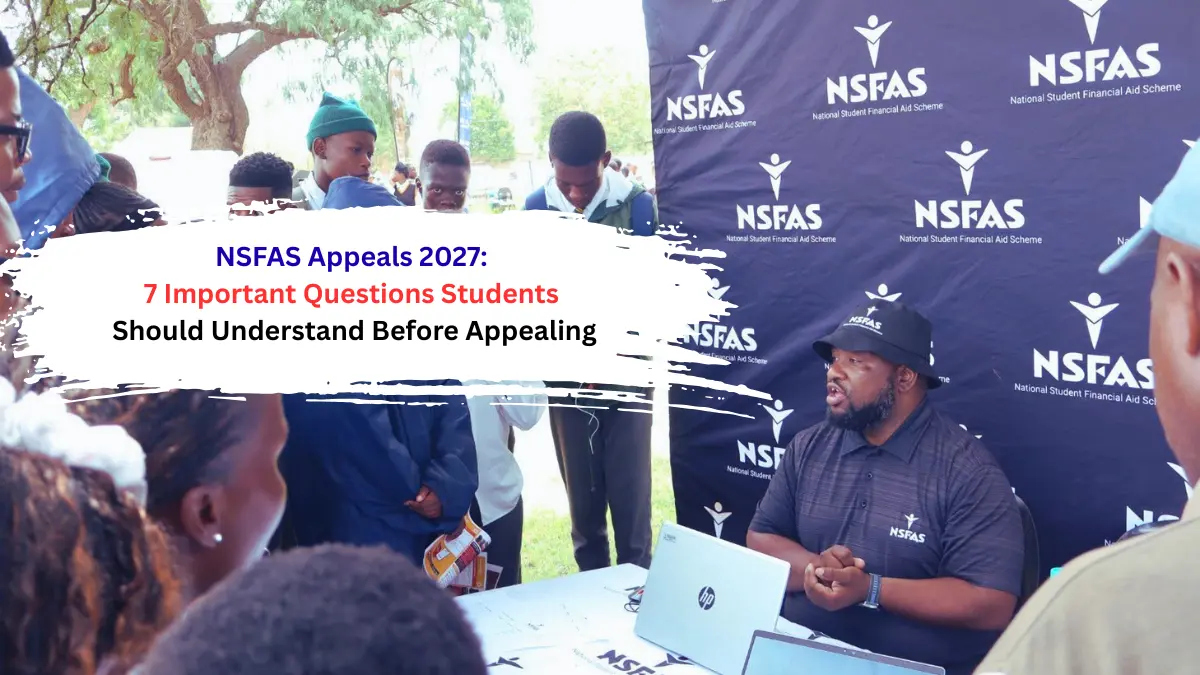
If a student has been unsuccessful as a NSFAS applicant for 2027 academic year, then he or she can try to appeal the decision. The appeal will not always be successful and certain requirements will need to be met.
An unsuccessful application for funding or a withdrawal of funding to a continuing student can be appealed. Students appealing must adhere to the instructions and rules provided in the official – NSFAS Appeals and policies – NSAFS appeals guidance. The written NSFAS appeals guidance indicates that you have 30 days to lodge an appeal after you have received the unsuccessful outcome, and the appeal is subject to the availability of funds. Read the NSAFS appeal procedures.
In addition, applicants have until 31 October 2026 at 23:59 (South African time) to make a funding application for the 2027 academic year. This is a cut-off date and some students may not be eligible to make an appeal. Students can verify their status and adhere to the relevant procedure depending on their situation. NSFAS application details for 2027.
Below are some of the frequently asked questions about NSFAS appeal, documents required and what to do if you’ve received an unsuccessful outcome.
1. How long Do I need to file an appeal?
As stated in the appeals guidance, students that meet the criteria for appeal and have received an unsuccessful outcome have 30 days from the date of their outcome to submit an appeal.
To make sure that the appeal has been submitted in the 30 days from the notice of result. The 30 days and successful login to check your result do not constitute as starting time for when you should file your appeal form. Please note that rejected application and the appeal for additional documents are two different applications. If the student is requested to submit additional documents, the applicant should do so before the deadline of submitting those additional documents.
Students need to double check the precise instructions on the official page as these could be altered for the 2027 cycle of appeals.
2. What Are the Grounds for an Appeal?
Students select one of the appeal reasons and must upload the relevant documentation to support their submissions.
The official guidance sets out how many appeals categories there are. For each appeal category, a student is required to submit certain evidence. The categories of consideration are as follows:
– Changes in household income
Applicants who were rejected on the basis of their household income exceeding the means test should submit the following: Updated information of the situation, e.g. whether a parent has lost a job, retrenched or has died. If child is divorced the decree must clearly state that the applicant is not dependant on his/her biological parents and that he/ she has not no obligation of the care and education of the applicant. If the applicant is divorced, a copy of the divorce order must be submitted if the divorced parent is the one who is caring for the child and complies with the means test. If household is child headed a letter from a registered social worker.
Please be aware that an improved financial position does not qualify as an appeal and the application may still be unsuccessful.
– Academic difficulties arising from serious circumstances
New students are not eligible for an appeal, but continuing students are. Continuing students may appeal to NSFAS if they have not met the conditions for funding for the next year of study. The official guidance states the following reasons for appealing for a continuing student:
– The student has been absent sick for at least two months in the course of the school year or in the exam period.
– An immediate family member died during the year.
– Name of student: a victim of a violent crime.
– The student became pregnant and delivered during the year of study.
– The student has a physical or mental disability which affected his or her studies. Here a medical report is to be provided to NSFAS.
– The result recieved by NSFAS was not correct and the student’s academic results are indeed eligible.
Please be aware that academic eligibility criteria vary between continuing and first time applicants. For example, published guidance sets out separate considerations for continuing and first time applicants in terms of the N+ rule.
– Surpass the N+ limit
What is the N+ limit with NSFAS?
The national advice does state that the exception is applicable to a student, in their final year, with a propensity letter from their university/ TVET college that indicates that they would be able to complete their studies within one additional academic term.
Students should check that they have met the terms stated in this guideline prior to making an appeal. Official guidance states that the N+ rule is usually not negotiable and an appeal will not be upheld unless the applicant belongs to one of the above categories.
An individual student requesting funding without paying all of their fees will not be awarded any additional funding even if they qualify for all of the above exceptions.
3. What is a propensity letter and do I need one?
A Propensity Letter can be issued by a university / TVET college to confirm that the student has the ability to complete their studies within the extended period.
This document is required under the exemption listed above for the N+ rule.
As per the published guidelines, students in their final year are to apply for a propensity letter if they are appealing the NSFAS N+ limit decision.
The proof of registration will be a document from your university or TVET college that you will have to request from them, it is not online. Some proof of registration will be required to appeal, for example, you might have to declare that you’ve been unable to study for a serious illness.
The student needs to be aware that however many of the four steps are completed, the appeal will not be guaranteed if all of the other requirements are not met, the student is applying under the correct category of appeal, and whether the funds are there.
4. What Documents Do I Need to Upload?
There is a requirement for students to upload all the supporting evidence needed to bring the appeal.
Examples of the document that you can submit for each appeal type are found on the official NSFAS appeals page.
Appeal reason Examples of documents
Changes in the household income or employment Latest SARS ITA34, proof of income, retrenchment or letter of termination or UIF records when applicable.
Provider of support to a household death relevant death certificate and other financial information as applicable.
Independent/financial independence Court order stating that the applicant is independent of their biological parents.
Single parent educational expenses Divorce decree applicable.
Child headed household Supporting report from registered social worker.
Significant disruption to studies Medical report or certificate covering the relevant period.
Death certificate and any additional evidence required.
Violent Crime relevant to research Evidence that supports the research, such as an official report.
Disability impacting school work Appropriate doctor’s report, and any documentation from the institution that may be needed.
6. What do I do if my status reads “Incomplete” or “Awaiting Documents”?
An incomplete submission is not a denied application.
There is a message in your myNSFAS account indicating that documents are outstanding. Read the message and upload the documents before the deadline.
The supporting-document forms and instructions to attach the documentation to an application for the 2027 application cycle are available on the website of NSFAS. The types of documents that have to be attached are determined by the applicant’s situation.
You may start from the NSFAS official website and the information in your myNSFAS account.
Before you submit:
Which document is missing.
Be ready to fill out any official Declaration or consent form.
If the document is require to be signed or certified.
The deadline shown in your notification.
If the uploaded file is well-lit and in focus?
Don’t submit a reason just because a document is absent. Comply with the outstanding-document directions until NSFAS has failed a decision that calls for an appeal.
7. What Happens After I Submit My Appeal?
Students should keep checking their myNSFAS accounts for progress in their appeals.
Make sure to keep a copy of the documents you uploaded and any confirmation from the portal.
Applicants also need to be aware that there is no guarantee when applying for an appeal for funding. NSFAS has stated that the outcome of an appeal depends on the budgets available to award funding and that you meet the necessary criteria.
If you do not understand the result or you think the matter has to do with an incorrect institutional record, please contact NSFAS or your institution using the official support channel.
NSFAS Appeals 2027: Important Information at a Glance
Question
Key information
What is the time limit for me to contest?
The official NSFAS memo states 30 days after an unsuccessful result.
Is it possible to challenge a grant removal?
Yes, eligible students who have registered to continue may make an appeal for a withdrawal decision.
Is it possible to appeal an N+ decision?
No. Restrictions apply, with limited exception for eligible final year students who satisfy the propensity letter criteria.
Do I have to supply proof?
Yes. Supporting documents relevant to the particular reason for appeal.
Should I appeal an incomplete application?
Typically, you will need to process this as before submitting any missing documents.
Does an appeal guarantee funding?
No. Whether you are funded depends on your eligibility and funding for the programme.
When do 2027 applications close?
African time. Funding applications are due by 23:59 South African time. This is not the same as the global appeal deadline.
Final Tips for NSFAS Applicants
Students appealed to an unsuccessful NSFAS decision. Find out why the application was unsuccessful, or why NSFAS revoked funding. The appropriate next step depends on whether you are referring to a financial, academic, N+ rule, document, or registration record.
If you meet the criteria, retain proof of any relevant conditions, adhere to the instructions on your myNSFAS account and appeal within the relevant time frame. Do not use unofficial channels, including social media, to determine what documentation to submit.
For the best sources of information, look to the official website of NSFAS appeals page and the NSFAS 2027 application page.
Sources and Checks
NSFAS: Appeals official appeal timeframes, eligibility limitations, grounds of appeal and supporting document samples.
NSFAS: How To Apply – nsfas application date 2027 and application instructions.
Official information about funding support for students with disabilities.
The article highlights the published NSFAS appeals guide to explain a typical appeals process. Students are advised to verify which appeals requirements are relevant to their own individual case, as grounds for appeal, document requests and processing instructions may differ.
Editorial Note
This article is an informational guide. This article is not an official NSFAS publication, and neither guarantees funding nor approval of any appeals. Students should make decisions about their applications based on the information available in their myNSFAS accounts and official NSFAS communications.
Corrections and Updates
There could be changes to the application process, required documentation or appeal information from the NSFAS. Time-sensitive info before applying Time-sensitive info before applying.
